
Tennis Racket Grip Size Chart
The right grip size lets you hold the racket firmly without squeezing, which helps control and reduces the strain that can lead to tennis elbow. Measure your hand with a ruler, read your size from the chart, and see how an overgrip changes it.
- Instant download
- Editable Word & Excel
- Print-ready PDF
- 7-day refund
5 files · PDF, DOCX, XLSX
Tennis Grip and Racket Pack
Printable tennis grip size chart, a hand measuring guide with ruler strip, a junior racket size chart, a string tension and restring log and a match and practice log.
- Grip chart (PDF/DOCX)
- Measuring guide (PDF)
- Junior chart (PDF/DOCX)
- + 2 more
$5.00 USD, one-time 5 files · about $1.00 each
- Instant download
- 7-day refund
- Secure checkout by Stripe
7-day money-back guarantee. Full refund within 7 days of purchase, even after you download.
Free sample: Grip Size Chart (PDF, 62 KB)
Tennis Grip and Racket Pack
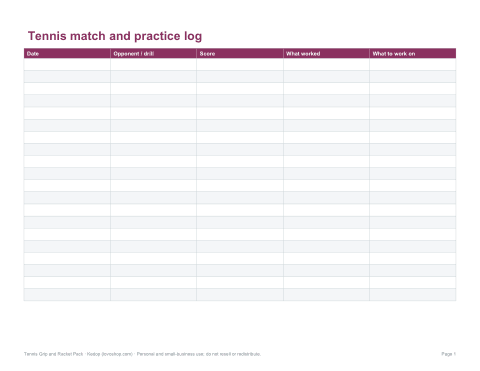
Printable tennis grip size chart, a hand measuring guide with ruler strip, a junior racket size chart, a string tension and restring log and a match and practice log.
- Grip chart (PDF/DOCX)
- Measuring guide (PDF)
- Junior chart (PDF/DOCX)
- Restring log (PDF/DOCX/XLSX)
- Match log (PDF/DOCX/XLSX)
Formats: PDF, DOCX, XLSX. Instant download after payment (link valid 72 hours, up to 5 downloads). AI-assisted: the templates were drafted with AI help and reviewed and laid out before publishing.
$5.00 USD, one-time 5 files · about $1.00 each
- Instant download
- 7-day refund
- Secure checkout by Stripe
7-day money-back guarantee. Full refund within 7 days of purchase, even after you download.
Free sample: Grip Size Chart (PDF, 62 KB)
Full refund within 7 days — see the refund policy and license.
Free printables
Single sheets you can print right now, no sign-up. The full pack adds every sheet in one download plus the editable files.
 Printable Tennis Grip Size Chart
 Printable Tennis Racket Grip Size Chart
 Printable Junior Tennis Racket Size Chart
 Printable Tennis Restring Log
 Printable Tennis Match Log
Use the tennis racket grip size chart
What’s in the pack
- Printable grip size chart (US, EU, mm)
- Hand measuring guide with a printed ruler strip
- Junior racket size chart by age and height
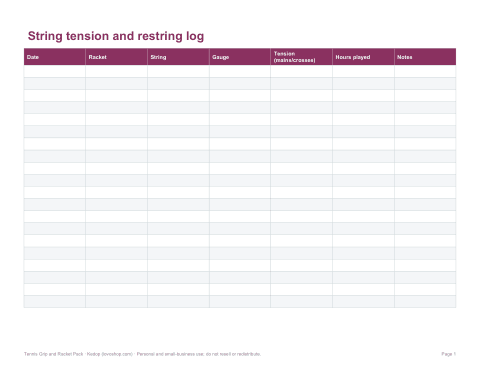
- String tension and restring log
- Match and practice log
Print the chart and measuring guide to take to a shop or club.
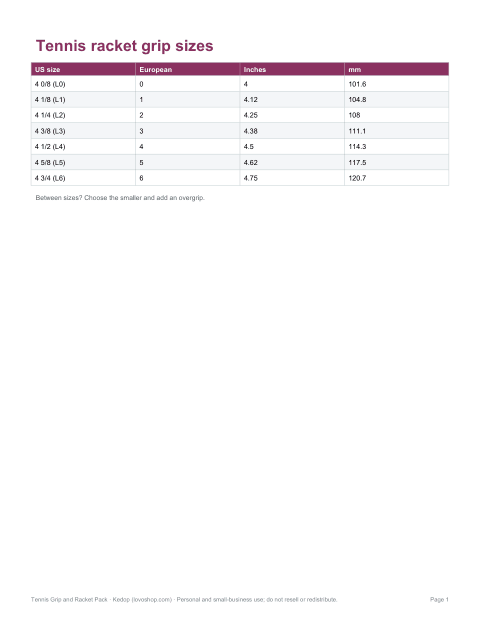
Tennis grip size chart
| US size | European | Circumference (in) | Circumference (mm) |
|---|---|---|---|
| 4 0/8 (L0) | 0 | 4 | 101.6 |
| 4 1/8 (L1) | 1 | 4.125 | 104.8 |
| 4 1/4 (L2) | 2 | 4.25 | 108 |
| 4 3/8 (L3) | 3 | 4.375 | 111.1 |
| 4 1/2 (L4) | 4 | 4.5 | 114.3 |
| 4 5/8 (L5) | 5 | 4.625 | 117.5 |
| 4 3/4 (L6) | 6 | 4.75 | 120.7 |
Grip size is the circumference of the handle. Most adult women use L1–L3 and most adult men L2–L4, but hand size, not gender, is what matters. L0 is common on junior and some women’s rackets; L5 and L6 are rare.
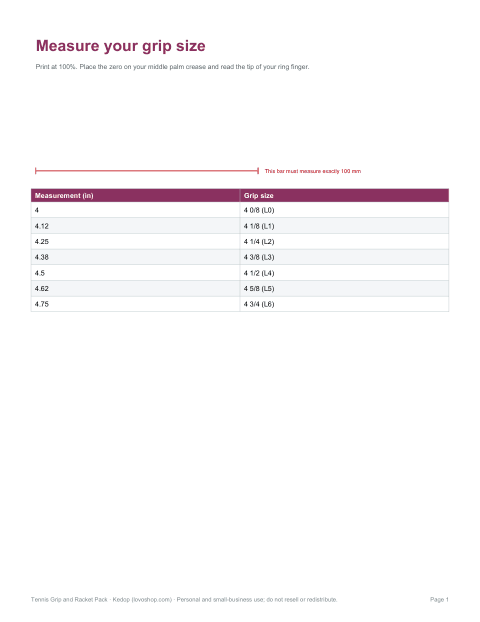
How to measure your grip size
- Hold your hitting hand open with the fingers together.
- Find the second (middle) crease across your palm — the lateral crease.
- Lay a ruler along your ring finger from that crease to the tip of the finger.
- Read the length in inches: 4¼ inches means an L2 grip, 4⅜ an L3.
- Cross-check with the finger test below on a real racket.
The finger test: hold a racket with an Eastern forehand grip. There should be room to fit the index finger of your other hand between the tips of your fingers and the heel of your palm. If there’s no room, the grip is too small; if there’s a gap, it’s too big.
Worked example
A player measures 4.3 inches from the palm crease to the tip of the ring finger — between L2 (4¼) and L3 (4⅜). Following the usual advice, they choose L2 and add one overgrip, which makes the handle feel about half a size bigger, close to 4 5/16 inches. The finger test confirms a snug fit with a thin gap for the index finger.
Overgrips and replacement grips
| Change | Effect on size |
|---|---|
| Add one overgrip | About +1/16 in — roughly half a size |
| Add two overgrips | About +⅛ in — about one full size |
| Replace the base grip with a thinner one | Slightly smaller |
| Heat-shrink sleeve under the grip | About one full size larger |
| Rebuild the handle (pallet) | Professional job to reduce the size |
Overgrips also absorb sweat and add tack; many players change them every few hours of play.
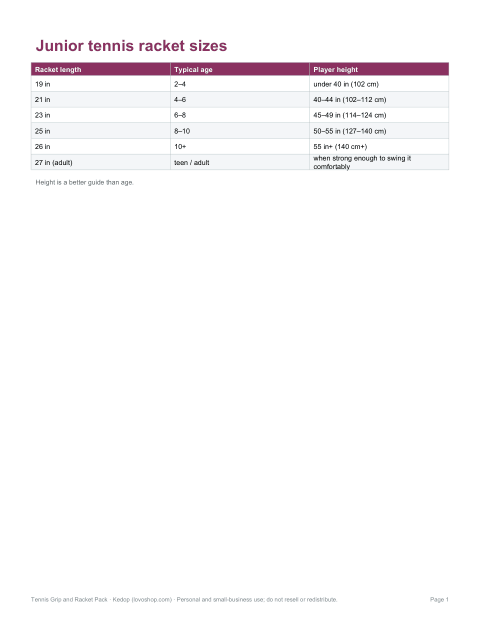
Junior racket sizes
| Racket length | Typical age | Player height |
|---|---|---|
| 19 in | 2–4 | under 40 in (102 cm) |
| 21 in | 4–6 | 40–44 in (102–112 cm) |
| 23 in | 6–8 | 45–49 in (114–124 cm) |
| 25 in | 8–10 | 50–55 in (127–140 cm) |
| 26 in | 10+ | 55 in+ (140 cm+) |
| 27 in (adult) | teen / adult | when strong enough to swing it comfortably |
Height is a better guide than age. A child should be able to hold the racket at arm’s length with the tip just off the ground when standing.
AI-assisted content
This chart and the templates were drafted with AI assistance and reviewed before publishing. Sizes are general guidance; try rackets before buying and seek coaching or medical advice for arm pain.
Frequently asked questions
What grip size do I need?
Measure from the middle palm crease to the tip of your ring finger; the length in inches is your grip size.
What is L2 grip size?
4 1/4 inches (108 mm), European size 2.
Should I go smaller or larger between sizes?
Smaller — you can add an overgrip to build it up.
How much does an overgrip add?
About 1/16 inch, roughly half a size.
Can a wrong grip cause tennis elbow?
A grip that’s too small or too large can increase strain; see a professional if you have pain.
Is the pack a subscription?
No, it’s a one-time download.